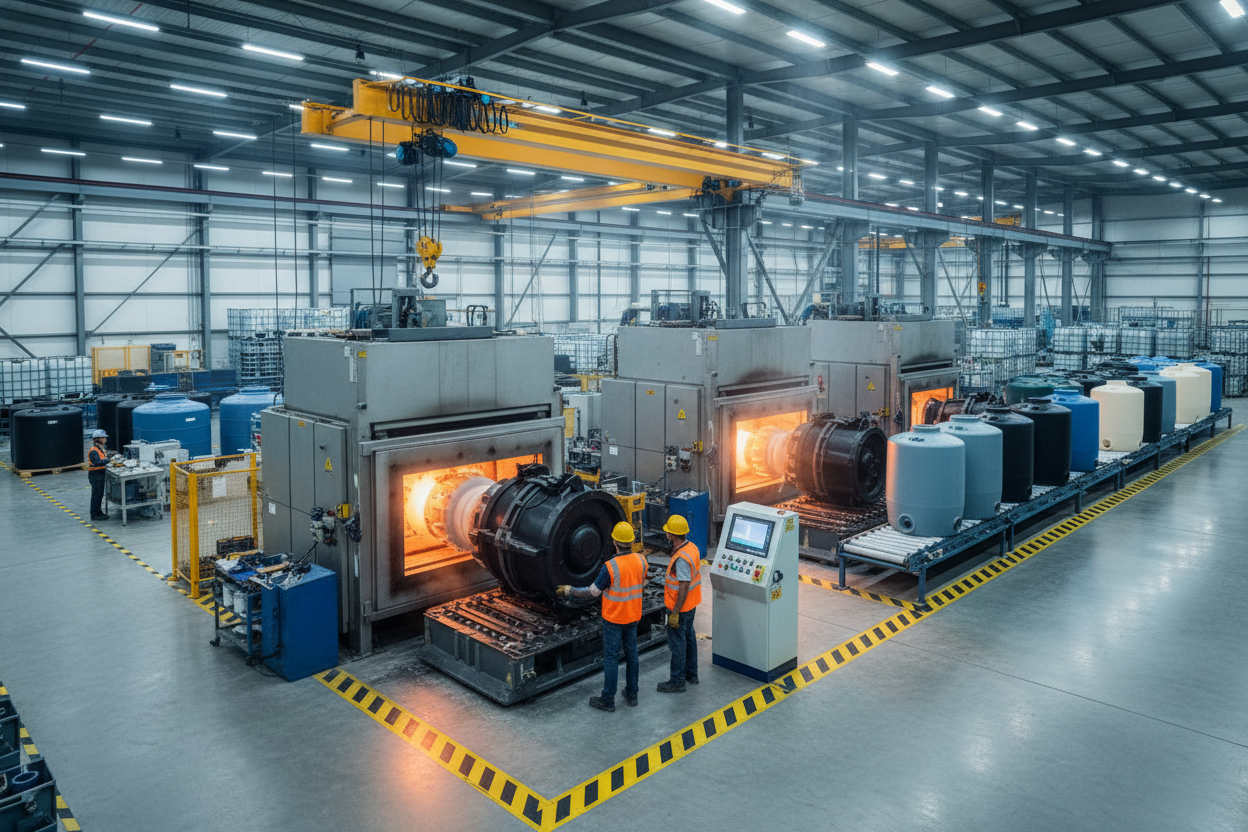
When shopping for replacement RV tanks, you've probably noticed something curious: most manufacturers list dimensions with a tolerance of ±1 inch. If you're used to precision-engineered parts, this might seem concerning. But there's a perfectly good reason for these variations, and it all comes down to the manufacturing process called rotational molding.

What is Rotational Molding?
Rotational molding (also called rotomolding) is a specialized manufacturing process used to create hollow plastic products like RV tanks. Unlike injection molding, which forces molten plastic into a mold under high pressure, rotational molding uses a completely different approach:
- Powder plastic resin is loaded into a hollow mold
- The mold is heated while rotating on two axes simultaneously
- As the plastic melts, centrifugal force distributes it evenly across the mold walls
- The mold is cooled while still rotating to solidify the plastic
- The finished tank is removed from the mold
This process creates seamless, one-piece tanks with no welds or joints—critical for preventing leaks in holding tanks and fresh water systems.
Premium Materials: What Your RV Tanks Are Made From
Fresh Water Tanks
Fresh water tanks must meet strict safety standards since they store your drinking water. Quality rotationally molded fresh water tanks are manufactured from:
- FDA-approved food-grade polyethylene – Safe for potable water contact
- NSF-certified materials – Meeting National Sanitation Foundation standards for drinking water systems
- UV-stabilized formulations – Preventing degradation from sunlight exposure
- Wall thickness of 0.125" to 0.180" – Providing structural integrity without excessive weight
These tanks are designed to operate safely in extreme temperature ranges from -40°F to 140°F, making them suitable for year-round RVing in any climate.
Holding Tanks (Black Water & Gray Water)
Holding tanks face different challenges—they must resist chemicals, odors, and the corrosive nature of waste water. Premium holding tanks feature:
- High-density black polyethylene (HDPE) – Superior chemical resistance
- UV-resistant construction – Preventing brittleness and cracking
- Thicker wall construction (0.180" to 0.20") – Some premium models feature walls up to 60% thicker than standard tanks
- Chemical-resistant formulations – Standing up to tank treatments and waste products
The black color isn't just aesthetic—it helps prevent algae growth and provides additional UV protection for tanks mounted in exposed locations.
Why Dimensions Vary: The ±1" Tolerance Explained
Here's where rotational molding differs significantly from other manufacturing processes. Several factors contribute to dimensional variations in rotationally molded tanks:
1. Thermal Expansion and Contraction
During the rotomolding process, plastic is heated to approximately 500-700°F and then cooled to room temperature. This dramatic temperature change causes:
- Material expansion during heating
- Shrinkage during cooling (typically 1.5-3% depending on the resin type)
- Uneven cooling rates in different areas of the tank, leading to slight dimensional variations
Thicker sections cool more slowly than thinner sections, which can create minor warping or dimensional changes as the part reaches equilibrium.
2. Mold Temperature Variations
Even with precise temperature control, different areas of the mold may heat and cool at slightly different rates due to:
- Mold geometry – Complex shapes with varying wall thicknesses
- Air circulation patterns in the oven
- Thermal mass differences in various mold sections
These variations can result in slightly different material distribution and final dimensions.
3. Material Flow and Distribution
Unlike injection molding where plastic is forced into every corner under pressure, rotational molding relies on gravity and centrifugal force. This means:
- Powder distribution may vary slightly between cycles
- Rotation speed and timing affect how evenly material coats the mold
- Corner and edge details may have minor variations in thickness
4. Mold Release and Part Removal
As the tank cools and solidifies, it naturally shrinks away from the mold walls. However:
- Different resin batches may have slightly different shrinkage rates
- Ambient temperature and humidity during demolding affect final dimensions
- Part geometry influences how the tank releases from the mold
5. Post-Manufacturing Settling
Even after removal from the mold, rotationally molded parts continue to undergo minor changes:
- Stress relief as internal stresses from cooling dissipate
- Dimensional stabilization over the first 24-48 hours
- Temperature equilibration to ambient conditions
6. Material Batch Variations
While manufacturers use consistent formulations, slight variations in raw materials can affect final dimensions:
- Resin density variations between batches
- Additive concentrations (UV stabilizers, colorants, etc.)
- Moisture content in the powder resin
Why This Matters (And Why It's Actually a Good Thing)
You might be thinking, "If dimensions can vary by an inch, how do I know it will fit?" Here's the important part: these variations are accounted for in the design process.
Benefits of Rotational Molding for RV Tanks:
- No seams or welds – Eliminates the most common failure points in tanks
- Uniform wall thickness – Better structural integrity than welded tanks
- Complex shapes – Can create tanks that fit unusual spaces
- Stress-free construction – No internal stresses from welding or bonding
- Cost-effective – Lower tooling costs than injection molding for large parts
What the ±1" Tolerance Really Means:
When a tank is listed as 39" x 18" x 14" with ±1" tolerance, the actual dimensions might be:
- Length: 38" to 40"
- Width: 17" to 19"
- Height: 13" to 15"
This is normal and expected. RV manufacturers design tank compartments with these tolerances in mind, typically providing 2-3 inches of clearance around the nominal tank dimensions.
Measuring Your Tank Space
When selecting a replacement tank, follow these guidelines:
-
Measure your tank compartment carefully, accounting for:
- Access panels and openings
- Plumbing connections and clearances
- Mounting strap locations
- Clearance for tank expansion when full
-
Allow extra space – If your compartment is 40" long, don't order a 40" tank. Choose a 37-38" nominal size to account for:
- Manufacturing tolerances
- Installation clearances
- Thermal expansion of the filled tank
- Consider drain orientation – For holding tanks, verify whether you need a left drain, right drain, or center drain configuration
- Check fitting locations – Some tanks come as "blank" configurations, allowing you to drill custom fitting locations
Quality Indicators in Rotationally Molded Tanks
When evaluating RV tanks, look for these signs of quality manufacturing:
- Consistent wall thickness (no thin spots or excessive thickness variations)
- Smooth interior surfaces (easier to clean, less odor retention)
- Proper material certifications (FDA/NSF for fresh water, chemical resistance for holding tanks)
- Reinforced fitting areas (thicker material around drain and fill locations)
- UV stabilization (especially important for externally mounted tanks)
The Bottom Line
The ±1" dimensional tolerance on rotationally molded RV tanks isn't a defect—it's an inherent characteristic of a manufacturing process that produces superior tanks. The seamless, one-piece construction, uniform wall thickness, and stress-free design far outweigh the minor dimensional variations.
When you understand why these variations occur and how to account for them during installation, you can confidently select the right replacement tank for your RV. The key is measuring your available space carefully and choosing a tank with nominal dimensions that provide adequate clearance.
Whether you're replacing a cracked fresh water tank or upgrading to a larger holding tank, rotationally molded tanks offer the durability, longevity, and leak-free performance that RV owners demand—even if they're not exactly 39.000 inches long.
Need help selecting the right tank for your RV? Use our AI Live Chat for personalized assistance with tank sizing, drain orientation, and compatibility questions. Our system has deep product knowledge to help you find the perfect fit.